Whether your organization depends on individual donations, foundation grants, membership contributions, or government funding, every dollar needs to be properly tracked and reported. Poor financial management can create compliance issues, make grant reporting difficult, and reduce donor confidence.
This is why nonprofit bookkeeping is essential. It provides the financial structure nonprofits need to manage resources responsibly, prepare reports, and demonstrate transparency.
In this guide, you will learn how nonprofit bookkeeping works, what records you need to maintain, how to manage donations and grants, and when outsourcing bookkeeping support may make sense for your organization.
What Is Nonprofit Bookkeeping?
Nonprofit bookkeeping is the process of recording, organizing, and maintaining the financial transactions of a nonprofit organization.
While traditional businesses focus primarily on revenue, expenses, and profitability, nonprofits focus on accountability and responsible use of funds. The goal is not to generate profit for owners but to ensure financial resources support the organization's mission.
Bookkeeping for nonprofits typically includes:
- Recording donations and contributions
- Tracking grants and funding sources
- Categorizing expenses
- Managing payroll and operational costs
- Reconciling bank accounts
- Preparing financial reports
- Maintaining documentation for audits and tax filings
For example, if a nonprofit receives a grant specifically for a community education program, the organization must track how those funds are received and spent. The money cannot simply be mixed with general operating expenses.
Accurate bookkeeping creates a clear financial picture and helps nonprofit leaders make better decisions.
How Does Bookkeeping for Nonprofits Work?
A strong nonprofit bookkeeping system follows consistent processes to keep financial information organized.
Create a Nonprofit Chart of Accounts
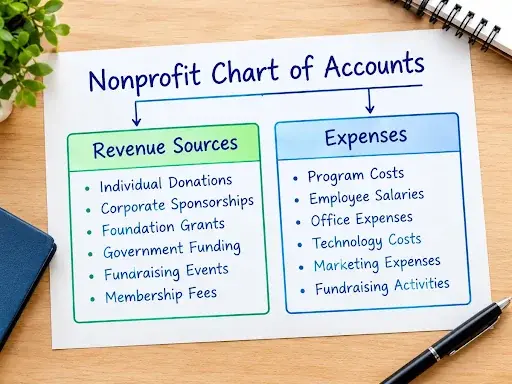
A chart of accounts is a financial filing system that categorizes every transaction.
For nonprofits, accounts are usually organized around:
Revenue Sources
Examples include:
- Individual donations
- Corporate sponsorships
- Foundation grants
- Government funding
- Fundraising events
- Membership fees
Expenses
Common nonprofit expenses include:
- Program costs
- Employee salaries
- Office expenses
- Technology costs
- Marketing expenses
- Fundraising activities
A properly structured chart of accounts makes nonprofit financial reporting easier and helps organizations understand where money is being used.
Track Every Financial Transaction
Every nonprofit should maintain records for incoming and outgoing money.
Important documents include:
- Donation receipts
- Grant agreements
- Vendor invoices
- Payroll records
- Bank statements
- Expense receipts
A common mistake small nonprofits make is waiting until tax season to organize financial information. Regular bookkeeping throughout the year prevents errors and reduces administrative stress.
Reconcile Bank Accounts Regularly
Bank reconciliation compares your internal records with your bank statements.
This process helps identify:
- Missing transactions
- Duplicate entries
- Incorrect payments
- Banking errors
Monthly reconciliation is a common practice because it keeps financial records accurate and allows nonprofit leaders to quickly identify problems.

Tracking Donations, Grants, and Restricted Funds
One of the biggest differences between nonprofit accounting and traditional business accounting is managing different types of funding.
Managing Donations Properly
Nonprofits often receive contributions from multiple sources. Each donation should be recorded with details such as:
- Donor information
- Amount received
- Date received
- Payment method
- Intended purpose
Accurate donation records help organizations provide proper acknowledgments to donors and prepare reliable financial reports.
Nonprofit Grant Tracking
Grants often come with specific requirements. A nonprofit receiving grant funding must monitor:
- Approved spending categories
- Grant deadlines
- Reporting requirements
- Remaining balances
For example, a healthcare nonprofit may receive funding for medical outreach programs. That funding may need to be separated from general administrative expenses.
Proper grant tracking ensures organizations meet funding obligations and maintain strong relationships with grant providers.
Understanding Restricted and Unrestricted Funds
Nonprofits commonly manage two types of funds.
Restricted Funds
Restricted funds must be used for a specific purpose defined by the donor or grant provider.
Example:
A donor gives money specifically to purchase school supplies for children. The nonprofit cannot use those funds for office rent or unrelated expenses.
Unrestricted Funds
Unrestricted funds can generally be used where the organization needs them most.
Examples include:
- General donations
- Membership income
- Flexible contributions
Proper restricted funds management helps nonprofits maintain transparency and financial compliance.
Nonprofit Financial Statements Every Organization Should Understand
Financial statements help nonprofit leaders, donors, and board members understand the organization's financial position.
Statement of Financial Position
This report provides an overview of:
- Assets
- Liabilities
- Net assets
It works similarly to a balance sheet used by businesses.
Statement of Activities
The statement of activities shows:
- Revenue received
- Expenses paid
- Changes in net assets
It helps organizations understand whether they are operating within their available resources.
Statement of Cash Flows
Cash flow reporting shows how money moves through the organization.
It helps nonprofits plan for:
- Future programs
- Payroll obligations
- Operational expenses
Functional Expense Statement
This report explains how nonprofit expenses are allocated between:
- Program services
- Administrative activities
- Fundraising efforts
This level of reporting helps demonstrate how donations support the organization's mission.
Common Nonprofit Bookkeeping Mistakes to Avoid
Even experienced nonprofit teams can make financial management mistakes.
Mixing Personal and Nonprofit Finances
A nonprofit should always maintain separate financial accounts.
Using personal accounts for organizational expenses creates confusion and makes reporting more difficult.
Poor Documentation
Missing receipts, invoices, or donation records can create problems during audits or financial reviews.
Maintaining organized documentation throughout the year is essential.
Ignoring Restricted Funds
Using restricted donations for unauthorized expenses can damage donor trust and create compliance concerns.
Every restricted contribution should be carefully tracked.
Not Reviewing Financial Reports
Bookkeeping is not only about recording transactions. Nonprofit leaders should regularly review financial reports to understand spending patterns and make informed decisions.
When Should You Outsource Nonprofit Bookkeeping?
Many organizations start by handling bookkeeping internally. However, as a nonprofit grows, financial management becomes more complex.
Outsourcing nonprofit bookkeeping services may be helpful when:
Your Organization Is Growing
More donors, grants, programs, and expenses create additional bookkeeping responsibilities.
Your Team Lacks Accounting Experience
Professional bookkeeping support can help ensure records are accurate and reports are prepared properly.
Grant Management Becomes More Complex
Organizations managing multiple funding sources often need specialized systems for tracking expenses and reporting.
You Need Better Financial Visibility
Outsourced nonprofit bookkeeping can provide:
- Organized financial records
- Regular reporting
- Improved compliance preparation
- Better budgeting support
Choosing between internal bookkeeping and outsourcing depends on your organization's size, budget, and financial needs.
Frequently Asked Questions
1. What is nonprofit bookkeeping?
Nonprofit bookkeeping is the process of recording and managing a nonprofit organization's financial transactions, including donations, grants, expenses, and operational costs.
2. How is nonprofit bookkeeping different from regular bookkeeping?
Nonprofit bookkeeping focuses on accountability, fund restrictions, donor requirements, and financial transparency rather than business profits.
3. What accounting software do nonprofits use?
Many nonprofits use accounting platforms such as QuickBooks Online, Xero, Aplos, and other nonprofit accounting software solutions depending on their needs.
4. Do small nonprofits need professional bookkeeping?
Small nonprofits may benefit from professional bookkeeping services if they manage multiple funding sources, grants, payroll, or complex financial reporting requirements.
5. How often should nonprofit financial records be updated?
Most nonprofits should update their books regularly, with many organizations reviewing and reconciling financial records monthly.
Conclusion
Effective nonprofit bookkeeping provides the financial foundation organizations need to operate responsibly and maintain donor trust. By tracking donations, managing grants, maintaining accurate records, and preparing clear financial reports, nonprofits can focus more on their mission and less on financial uncertainty.
Whether you manage a small charity or a growing nonprofit organization, investing in proper bookkeeping systems can improve transparency, compliance, and long-term sustainability.